World Blood Donor Day rightly celebrates the millions of people who give whole blood. That choice saves lives, and more people should know they can do it. But many blood donors don't realise there's a second, entirely separate path: joining a stem cell registry and potentially donating peripheral blood stem cells to a patient who has no other option. We explore the operational responsibilities that follow a PBSC donation and why they demand unyielding standards.
The peripheral blood stem cell donation process
A whole blood donation takes under an hour, whereas a peripheral blood stem cell (PBSC) donor undergoes days of G-CSF injections to mobilise stem cells into the bloodstream, then attends a specialist apheresis collection centre for a procedure lasting four to five hours, donating something highly targeted, to one specific patient, at a moment that, once the patient's conditioning regimen begins, cannot be rescheduled.
This is where our work begins.
Two types of donor, One awareness gap
In the UK, potential PBSC donors join one of four registries: Anthony Nolan, DKMS UK, the NHS Stem Cell Donor Registry, or the Welsh Bone Marrow Donor Registry. All four are aligned as a single searchable register when clinicians are looking for a patient match. Joining is straightforward. In many cases, an additional blood sample taken during an existing donation appointment is all that's required to register.
But being called to actually donate is more complex. When a match is identified and confirmed, the donor undergoes a course of granulocyte colony-stimulating factor (G-CSF) injections over four days. These mobilise haematopoietic progenitor cells (HPCs) from the bone marrow into the peripheral bloodstream, where they can be collected via apheresis. Around 90% of stem cell donations in the UK now use this method, with bone marrow harvest used in the remaining cases.
The resulting material, HPC(A), collected via apheresis, is one of the most clinically sensitive biological products in transplant medicine. It has a narrow therapeutic window, cannot be replaced if compromised, and must be moved from collection to a cryopreserved clinical product within a tightly controlled timeframe.
That is the point at which the custody chain begins.
The custody chain: what it actually involves
As the accredited tissue bank supporting the NHS South West Peninsula Transplant Service, Biovault Technical manages this transition for allogeneic donor-derived cellular therapies. The following is a summary of the quality-control checkpoints our team conducts for every product line; not as a procedural formality, but as the operational foundation on which a patient's transplant depends.
01 / Logistics and chain of custody
On arrival from the apheresis collection centre, all HPC(A) and donor lymphocyte infusion (DLI) materials are immediately verified against HTA and JACIE chain-of-custody requirements. Documentation, labelling, and transport conditions are reviewed before any further handling proceeds. This step is not administrative: it is the first clinical decision point. Any deviation here stops the process.
02 / Environmental governance
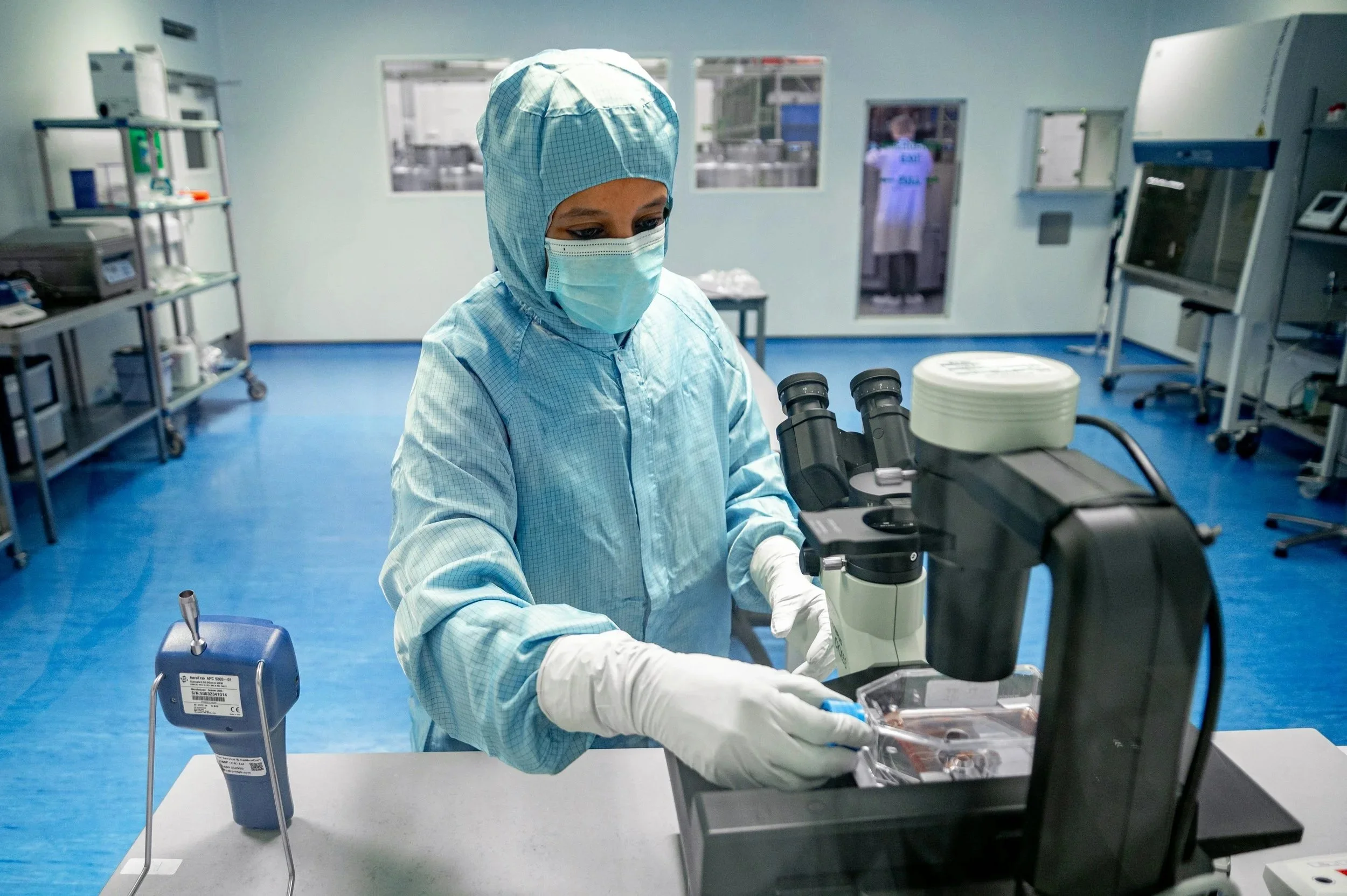
All open processing of apheresis-derived products takes place within strictly monitored cleanroom environments. Particle counts, pressure differentials, and personnel access are continuously controlled. Contamination risk is managed at source, not retrospectively. The cleanroom is not a backdrop; it is a controlled variable.
03 / Flow cytometry analysis
Advanced flow cytometry is used to confirm absolute CD34+ cell enumeration and viability scores before any formulation step proceeds. These figures determine whether a product meets the advancement threshold or requires review. For a transplant team waiting on a conditioning regimen, this is the data that governs timing.
04 / Fractionation of donor lymphocyte infusions
Therapeutic lymphocyte sub-opulations are precisely isolated to support post-transplant protocol demands. DLIs are highly effective in managing relapse or incomplete engraftment by leveraging a "graft-versus-tumour" effect; however, because they introduce mature donor T-cells, they inherently carry a high risk of triggering severe Graft-versus-Host Disease (GvHD). To mitigate this, our laboratory performs meticulous fractionation and precise cellular dosing. Controlled processing at this stage is the vital safeguard that allows clinicians to deliver the necessary therapeutic benefit while actively minimising downstream GvHD risk for the recipient.
Deep Dive: While DLIs are increasingly guided by early warning signs like minimal residual disease (MRD) and chimerism changes, many facilities still generate them reactively, introducing critical delays. Read our full feature on Why Advance DLI Preparation is Transforming Post-Transplant Care to see how we eliminate this uncertainty.
05 / Controlled-rate freezing
Living cell suspensions undergo automated, validated, controlled-rate freezing. The programme is optimised to prevent intracellular ice formation and preserve membrane integrity across the entire product volume. This is not a generic freeze-down; it is a validated, documented and auditable curve specific to the product type.
06 / Cryogenic vapour phase infrastructure
Finished products are held in liquid nitrogen vapour phase at ≤ −150°C. Automated telemetry provides continuous temperature monitoring with redundant backup systems. No product is ever left without verified cold-chain integrity. A fraction of a degree of undetected variance at this stage can compromise therapeutic viability entirely, without any visible indication until the product is assessed at the point of use.
07 / Certified release for clinical deployment
Final release is governed under HTA, JACIE, and MHRA compliance frameworks. Every product that leaves Biovault Technical arrives at the transplant team with a complete, auditable quality record and full confidence in its therapeutic viability. The release decision is not a signature; it is the endpoint of a documented chain of evidence stretching back to the moment of receipt.
Why the margin for error is zero
Allogeneic transplantation is a one-shot intervention. The donor has been identified, mobilised, and collected. The patient has undergone conditioning, a process that ablates their own immune system in preparation for engraftment. There is no fallback.
If a product is compromised at any point in the custody chain, through a documentation gap, a temperature excursion or an inadequate viability result that was not flagged, the consequences are not recoverable within the transplant window.
This is the operational reality that JACIE accreditation exists to govern, and that our team works to uphold on every product that passes through our facility.
For donors who don't know they can help
If you already give blood, platelets, or plasma in the UK, you may be eligible to join the NHS Stem Cell Donor Registry with nothing more than an additional blood sample at your next appointment. Anthony Nolan and DKMS UK also recruit independently.
Joining the register costs you nothing and commits you to nothing immediately. Being called as a match is rare. But for the patient who needs you, there is no alternative.
World Blood Donor Day is the right moment to know that both paths exist.
References
Anthony Nolan. (n.d.). What happens when you donate stem cells? https://www.anthonynolan.org/savelives/donate-your-stem-cells
British Society for Blood and Marrow Transplantation and Cellular Therapy (BSBMTCT). (2022). The UK transplantation registry annual report. BSBMTCT. https://bsbmtct.org/
DKMS UK. (n.d.). What is a peripheral blood stem cell (PBSC) donation? https://www.dkms.org.uk/
Foundation for the Accreditation of Cellular Therapy & Joint Accreditation Committee ISCT-Europe & EBMT (FACT-JACIE). (2024). International standards for hematopoietic cellular therapy product collection, processing, and administration (8th ed.). http://www.jacie.org/
Human Tissue Authority (HTA). (2023). Code of practice A: Guiding principles and the fundamental principle of consent. https://www.hta.gov.uk/
Joint United Kingdom Blood Transfusion Services Professional Advisory Committee (JPAC). (2024). Guidelines for the blood transfusion services in the United Kingdom (8th ed.). Blood Transfusion Services / TSO. https://www.transfusionguidelines.org/
Medicines and Healthcare products Regulatory Agency (MHRA). (2022). Rules and guidance for pharmaceutical manufacturers and distributors (The Orange Guide). Pharmaceutical Press.
World Marrow Donor Association (WMDA). (2023). Global trends in hematopoietic stem cell donation and transplantation. WMDA. https://wmda.info/