

As more than 6,000 delegates gathered in Madrid for the 52nd Annual Meeting of the European Society for Blood and Marrow Transplantation (EBMT), one thing became clear: cell therapy is moving from innovation to operational maturity.
From expanded cord blood to inspection burden and from regulatory evolution to quality system integration, EBMT 2026 focused less on what’s possible and more on what’s sustainable, scalable and safe.
For Biovault, it was another inspiring week of learning, collaboration and forward thinking across a rapidly evolving field.
Here are our key insights from EBMT 2026.
1. Quality Systems Are Becoming Smarter, Not Just Stronger
The JACIE Quality Management Day once again proved to be one of the most insightful parts of the conference, highlighting how quality systems are evolving alongside increasingly complex therapies.
One standout moment came from Charles Crawley, who used a DVD player analogy to describe the shift from fragmented quality systems to fully integrated programmes. The message was simple but powerful: Disconnected systems create friction. Integrated systems create resilience.
This reflects a broader shift across the industry, where quality is no longer seen as compliance alone, but as an enabler of safe innovation. Crawley, who currently plays a leadership role within the JACIE Working Party, emphasises that standards must support innovation while safeguarding quality, particularly as therapies extend beyond traditional transplant settings.
Also memorable was Suzanne van Dorp’s reference to the Dutch phrase “Paarse Krokodil” (Purple Crocodile) — shorthand for unnecessary bureaucracy. Her message resonated strongly across the room: Reduce inspection burden. Focus on meaningful quality. Enable progress. This is a theme we've seen building across EBMT in recent years, but in 2026 it felt more practical, more urgent and more actionable.
2. Expanded Cord Blood Is Back in Focus
One of the most discussed scientific sessions came from Guy Sauvageau, who presented on expanded cord blood technologies. Cord blood has long offered advantages such as greater donor availability and lower chronic GVHD risk, but limitations in cell dose have historically restricted wider adoption.
New expansion technologies, including UM171-expanded cord blood, are now addressing this challenge, improving engraftment and expanding the potential use of cord blood in adult patients and advanced cellular therapies.
New data presented around expanded cord blood therapies (including dorocubicel / Zemcelpro) continue to show promising survival outcomes in high-risk blood cancers, highlighting renewed momentum for this source material. The takeaway? The future of cellular therapy will likely rely on multiple cell sources, not just one, and cord blood may once again play a central role.
3. Regulation Is Evolving: SoHO and the Changing Landscape
Another recurring theme during EBMT 2026 was the evolving regulatory environment, particularly regarding SoHO (Substances of Human Origin). SoHO regulation aims to harmonise safety and quality standards across Europe while expanding protections for donors and patients.
The regulation broadens the definition of human-derived materials and introduces new requirements for traceability, continuity and quality management across the entire lifecycle of therapies. For organisations working with cellular therapies, this signals:
Greater harmonisation across Europe
Stronger governance
Increased operational complexity
In other words, quality infrastructure becomes even more critical.
4. The Industry Is Moving From Innovation to Implementation
Across sessions and conversations, a consistent message emerged: The science is accelerating; now infrastructure must keep up.
This includes:
Manufacturing scalability
Logistics resilience
Inspection readiness
Data traceability
Cross-border collaboration
These themes align closely with discussions from previous EBMT meetings, but in 2026, they felt less theoretical and more operational. Cell therapy is no longer emerging. It is becoming standard of care.

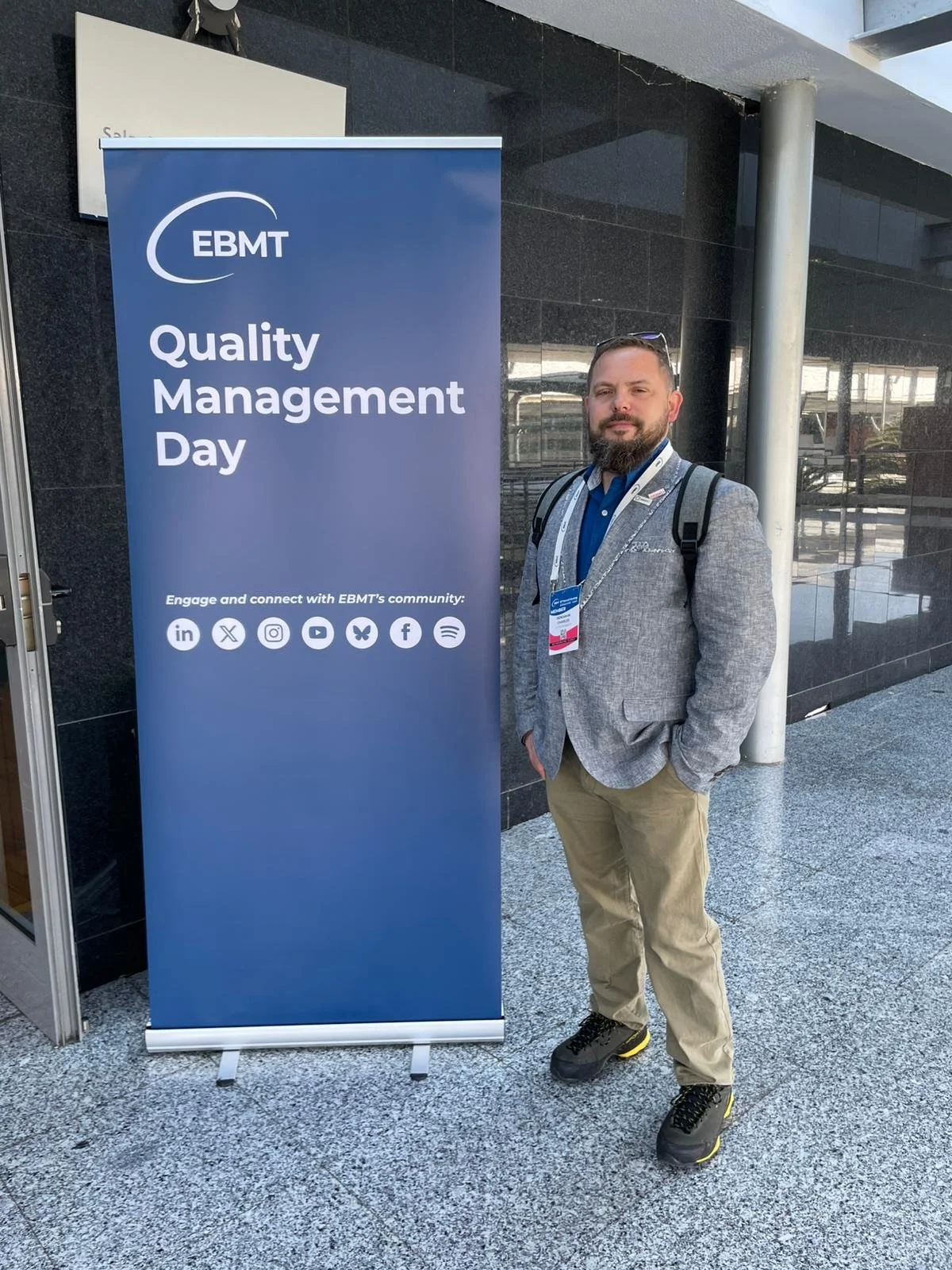
Biovault’s Managing Director Ben Charles at EBMT26
5. Community Still Drives Progress
As always, the EBMT community remains one of the most collaborative in healthcare. From Lab Scientists Day to JACIE sessions and the networking event at the Galería de Cristal, EBMT 2026 reinforced that progress is driven not just by science, but by shared learning and shared standards.
Even beyond the conference sessions, the event reflected the wider impact of collaboration, with initiatives such as blood donation campaigns across Madrid highlighting the link between knowledge sharing and patient care.
Share knowledge. Share life.
A fitting theme for the week.
Looking Ahead
EBMT 2026 confirmed what we’ve been seeing across recent years:
Quality systems are becoming more integrated
Regulation is evolving
Cell sources are diversifying
Infrastructure is becoming critical
Collaboration remains essential
From expanded cord blood to smarter quality systems, the future of cellular therapy is not just about innovation; it is about readiness.
And as the field continues to grow, Biovault remains committed to supporting partners with the experience, infrastructure and standards required to deliver better care and better outcomes.
Until next year.
References and further reading
EBMT 2026 Conference & Programme
European Society for Blood and Marrow Transplantation. 52nd Annual Meeting of the EBMT (Madrid, 22–25 March 2026)
https://www.ebmt.org/annual-meeting-2026EBMT 2026 Scientific Programme
https://www.ebmt.org/annual-meeting/programmeEBMT 2026 Abstract Programme
https://ebmt2026.abstractserver.com/programme/EBMT Annual Meeting Overview (Attendance & Purpose)
https://www.ebmt.org/annual-meeting/aboutEBMT 2026 Event Overview (IFEMA Madrid)
https://www.esmadrid.com/en/whats-on/european-society-blood-and-marrow-transplantation-ebmt-annual-meeting-2026-ifema-madrid
JACIE & Quality Management
JACIE Working Party — EBMT
https://www.ebmt.org/working-parties/jacie-working-partyJACIE Assurance Committee (including Charles Crawley)
https://www.ebmt.org/jacie-assurance-committeeFACT-JACIE Standards Update (2025–2026)
https://www.ebmt.org/ebmt/news/new-fact-jacie-standards-edition-demand-webinar-key-changesJACIE Activity Report 2025
https://www.ebmt.org/annual-report-2025/jacie-activity-report-2025
Expanded Cord Blood & Guy Sauvageau
Zemcelpro® (UM171 Expanded Cord Blood) EBMT 2026 Data
https://www.prnewswire.com/news-releases/zemcelpro-dorocubicel-positive-results-in-high--and-very-high-risk-blood-cancers-to-be-reported-at-the-ebmt-2026-annual-meeting-302708650.htmlUM171 Expanded Cord Blood Clinical Trial (Phase II)
https://clinicaltrials.gov/study/NCT03913026UM171 Cord Blood Outcomes Research
Blood Advances Journal
https://ashpublications.org/bloodadvances/article/7/19/5717/496897UM171 Cord Blood Survival and GVHD Outcomes
https://pmc.ncbi.nlm.nih.gov/articles/PMC10539875/Zemcelpro® / UM171 Expanded Cord Blood Overview
https://excellthera.com/news/zemcelpro-um171-cell-therapy-improved-outcomes-compared-with-common-graft-sources-european-real-world-evidence/
SoHO Regulation (Substances of Human Origin)
European Commission — SoHO Regulation Overview
https://health.ec.europa.eu/blood-tissues-cells-and-organs/soho-regulation_enNew EU Rules on Substances of Human Origin (2024 Regulation)
https://health.ec.europa.eu/blood-tissues-cells-and-organs/soho-regulation/new-eu-rules-substances-human-origin_enSoHO Regulation Implementation Timeline
https://www.centronazionalesangue.it/en/european-parliament-approves-new-soho-regulation/Regulatory Scope Expansion (Cells, tissues, blood)
https://agence-biomedecine.fr/en/reglement-europeen-substance-of-human-origine-soho
Additional EBMT 2026 Context & Coverage
GvHD Hub — EBMT 2026 Congress Coverage
https://gvhdhub.com/medical-information/ebmt-2026-live-congress-coverage-from-the-gvhd-hubEBMT Scientific Committee Commentary (Data sharing & collaboration)
https://www.ebmt.org/ebmt/news/ebmt-2026-annual-meeting-scientific-committee-co-chair-antonio-perez-martinez